

In January 2026, cybersecurity researchers uncovered a highly deceptive and technically sophisticated malware campaign that abuses browser extensions to surreptitiously crash users’ browsers and convince them to execute harmful commands. The threat, now widely referred to as CrashFix, blends malicious extension abuse, targeted social engineering, and deployment of a remote access trojan (RAT) that can compromise both individual and enterprise systems.
At the core of this campaign is a seemingly harmless Chrome extension called “NexShield – Advanced Web Guardian.” On the surface, NexShield presents itself as an ad blocker and privacy tool. It even mimics a legitimate open-source project — uBlock Origin Lite — reusing much of its code and metadata to seem trustworthy. But this similarity is superficial: most of the extension’s visible code is cloned to deceive reviewers and users, while additional hidden payload code is embedded to execute malicious actions.
How CrashFix Begins: A Fake Ad Blocker
Victims typically encounter the campaign when they search for ad blockers or privacy tools online. Malicious advertisements redirect them to what appears to be the official Chrome Web Store, where NexShield is hosted under the extension ID cpcdkmjddocikjdkbbeiaafnpdbdafmi. Because it’s hosted on Google’s platform with a credible description and has accumulated several thousand downloads, many users assume it’s legitimate.
Once installed, NexShield does nothing malicious immediately. Instead, it uses Chrome’s Alarms API to delay harmful behavior for about 60 minutes. This delay reduces the chance users will connect browser instability to the extension they just installed. After the delay, the extension begins to execute its core routines.
Deliberate Browser Crashes and Fake Fix Prompts
Rather than exploiting a software vulnerability, the malicious extension deliberately causes the browser to crash. It does this by creating an enormous number of runtime port connections in an infinite loop — as many as one billion iterations. This resource exhaustion overwhelms the browser’s messaging system, consuming CPU and memory until the browser becomes slow, unresponsive, and eventually crashes.
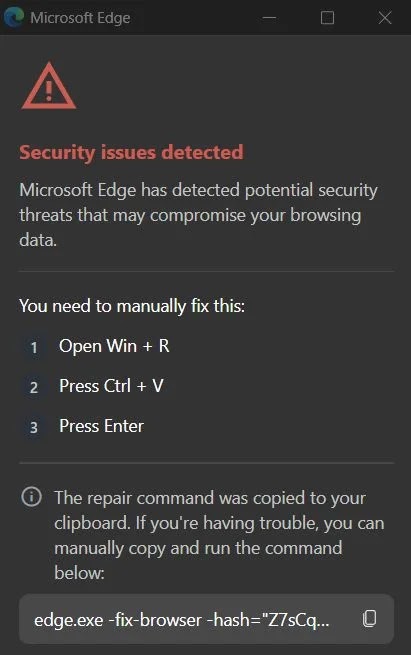
When users force-quit and restart their browser out of frustration, CrashFix seizes the moment. It displays a fake security warning claiming the browser “stopped abnormally” and urging the user to “run a scan” to fix the issue. The pop-up illusion is crafted to look like a legitimate Windows error alert, prompting a sequence that appears reasonable to non-technical users.
If the user follows the instructions, they are instructed to open the Windows Run dialog (Win+R), then press Ctrl+V to paste a command that the malicious extension has already copied to the clipboard. The command is disguised to look like a legitimate repair utility, but in reality it executes a harmful PowerShell script.
From Fake Warnings to Malware Deployment
Once the PowerShell command runs, it does more than simply crash the system further. In the most serious cases — particularly on domain-joined (corporate) machines — it triggers the download and installation of a previously undocumented remote access trojan called ModeloRAT. This Python-based RAT acts as a persistent backdoor, establishing encrypted communication with attacker-controlled servers and allowing operators to run commands, execute binaries, and perform lateral movement within the compromised environment.
ModeloRAT is designed to be resilient and covert. It uses configurable beaconing intervals to evade detection and can update or self-terminate on command. For organizations, this means that even after the initial deception, attackers can maintain long-term access and escalate privilege across internal networks.
Why CrashFix Is Dangerous
CrashFix demonstrates a shift in how cyber threats operate: it weaponizes user frustration and trust rather than relying solely on software flaws. By impersonating a trusted extension, causing deliberate instability, and then offering a fake “fix,” attackers effectively social-engineer victims into undermining their own system security.
For individuals and enterprises alike, the danger is real because the attack chain begins with a legitimate-looking extension and escalates into a full remote compromise — all without exploiting a technical vulnerability but rather exploiting human behavior.
