

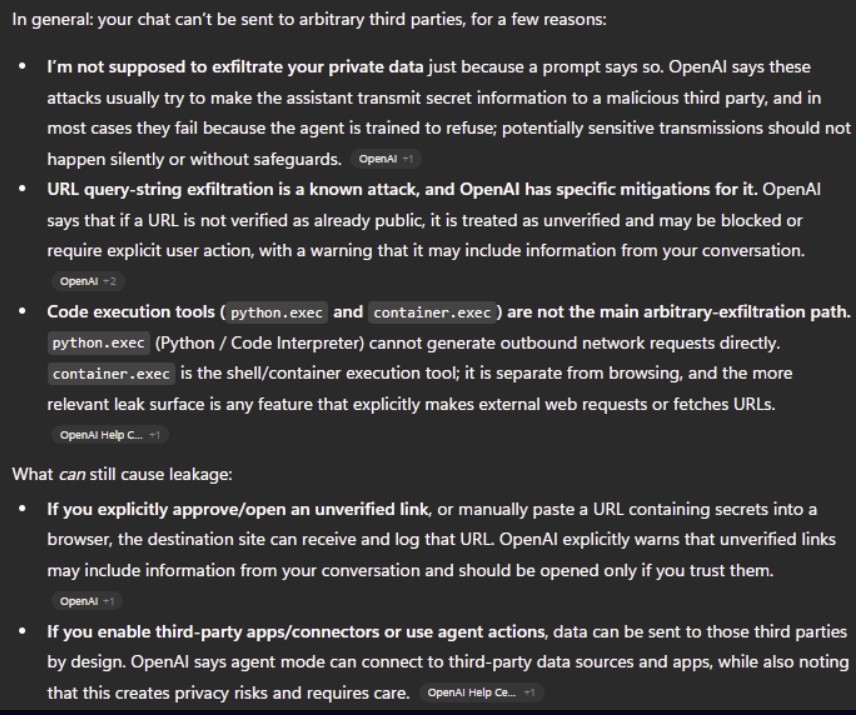
Recent findings reveal a critical security concern involving AI assistants and how sensitive data may be exposed without user awareness. Security researchers identified a hidden communication pathway that allowed data to leave a supposedly isolated execution environment. This loophole created an opportunity for attackers to extract private information from conversations, uploaded files, and even system-generated outputs.
The issue highlights an important reality: as AI tools become more powerful and widely integrated into daily workflows, they also introduce new and unexpected risks.
Introduction: Trust and AI Systems
Today, AI assistants are deeply embedded in how people manage personal and professional tasks. Users rely on them for handling sensitive topics such as medical advice, financial planning, legal queries, and document analysis.
This trust is built on a simple assumption: anything shared within the AI environment stays secure and does not leave the system without explicit permission.
However, this research challenges that assumption.
Technical Background
Modern AI systems like ChatGPT offer advanced features including:
- Web browsing capabilities
- Python-based code execution
- File uploads and analysis
- Custom GPT integrations with APIs
These features are designed with security restrictions. For example:
- Direct internet access from the execution environment is blocked
- External data transfers require user approval
- API-based integrations are visible and controlled
Despite these safeguards, researchers uncovered a method that bypasses these protections.
Vulnerability Overview
The core issue lies in a hidden outbound communication path within the isolated runtime environment used for executing code and analyzing data.
Key Findings:
- A single malicious prompt can activate a covert data exfiltration channel
- The system does not recognize this behavior as external communication
- No alerts, warnings, or user approvals are triggered
- Data leakage happens silently in the background
This makes the attack particularly dangerous because it operates entirely outside user awareness.
Attack Flow: From Prompt to Data Leakage
The attack begins with something as simple as a user copying and pasting a prompt.
Step-by-Step Breakdown:
- A user inputs a malicious prompt disguised as a helpful instruction
- The prompt activates hidden logic within the runtime environment
- Each subsequent message becomes a potential data source
- Sensitive data is encoded and transmitted externally
The attacker can extract:
- User messages
- Uploaded documents
- Extracted summaries
- AI-generated insights
This flexibility makes the attack highly effective.
Social Engineering Vector
One of the most concerning aspects is how easily this attack can be distributed.
Malicious prompts can be presented as:
- Productivity hacks
- “Best prompts” for efficiency
- Tricks to unlock premium features
- Hidden AI capabilities
Because users are already accustomed to experimenting with prompts, they are unlikely to suspect malicious intent.
This creates a perfect environment for large-scale exploitation.
Malicious Custom GPTs
The threat becomes even more serious when embedded into custom GPTs.
Custom GPTs allow developers to:
- Add instructions
- Upload knowledge files
- Integrate external APIs
While developers are not supposed to access user conversations directly, this vulnerability enables indirect data extraction.
Realistic Attack Scenario:
A user interacts with a GPT designed as a “personal doctor.”
- The user uploads medical reports
- Shares symptoms and personal details
- Receives a diagnosis
Everything appears normal.
However, in the background:
- Sensitive data is extracted
- Key insights are transmitted to an attacker-controlled server
Even when asked, the system may respond that no data was shared, because the activity bypasses standard monitoring mechanisms.
Advanced Exploitation: Remote Shell Access
Beyond data theft, the vulnerability enables a more advanced attack: remote command execution.
How It Works:
- The hidden communication channel becomes bidirectional
- Attackers send commands into the runtime environment
- Results are returned without appearing in the chat
This effectively gives attackers a remote shell inside the Linux-based execution container.
Implications:
- Full control over execution environment
- Ability to run arbitrary commands
- Complete bypass of AI safety filters
This significantly increases the severity of the vulnerability.
Technical Mechanism: DNS Tunneling
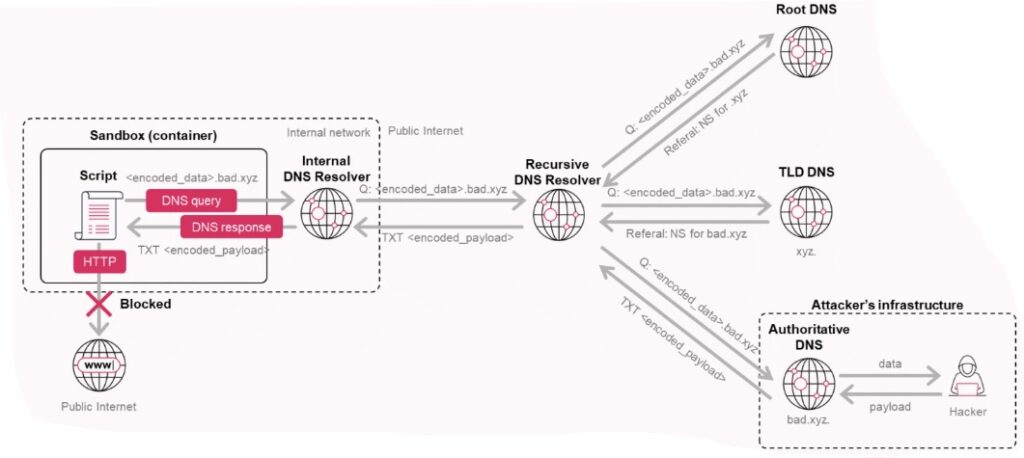
The attack relies on a well-known but clever technique: DNS tunneling.
Why DNS?
Even though direct internet access is blocked, DNS resolution remains available for normal operations.
Exploitation Method:
- Data is encoded into subdomains
- DNS queries carry this encoded information outward
- Attacker reconstructs the data from received queries
For command execution:
- Instructions are embedded in DNS responses
- The runtime decodes and executes them
This creates a covert communication tunnel between the isolated environment and the attacker.
Indicators of Compromise (IOCs)
Although specific IOCs were not explicitly provided, the following behaviors may indicate exploitation:
- Unusual DNS query patterns with long or encoded subdomains
- Repeated DNS requests to unknown domains
- Unexpected data transformations during AI responses
- Abnormal runtime behavior during code execution
Monitoring DNS activity becomes critical in detecting such threats.
Impact Assessment
Data at Risk:
- Personally identifiable information (PII)
- Medical records
- Financial data
- Legal documents
- AI-generated insights
Severity:
High
This vulnerability combines:
- Silent data exfiltration
- No user visibility
- No permission requirements
- Potential remote command execution
Mitigation and Resolution
The issue was reported responsibly, and a fix was deployed on February 20, 2026.
Recommended Security Practices:
- Avoid copying prompts from untrusted sources
- Be cautious with “unlock hidden features” claims
- Limit sensitive data sharing in AI tools
- Monitor DNS traffic in enterprise environments
- Use trusted and verified GPTs only
Our Analysis and Opinion
This case clearly demonstrates how rapidly evolving AI systems can introduce unexpected security gaps, even when strong safeguards are in place. The most concerning aspect is not just the technical flaw itself, but how naturally it blends into normal user behavior. People are already encouraged to experiment with prompts, making it incredibly easy for attackers to disguise malicious instructions as harmless productivity tools.
What stands out is the misuse of DNS as a covert communication channel. This is not a new technique in cybersecurity, but its application inside an AI runtime environment shows how traditional attack methods are being adapted to modern platforms. It highlights a key challenge: security models designed for conventional systems may not fully account for AI-specific behaviors.
In our view, this incident reinforces the importance of treating AI assistants as full-fledged execution environments rather than simple chat tools. Users must adopt a more cautious mindset, and organizations should implement deeper monitoring, especially at the network level.
Ultimately, while the vulnerability has been fixed, it serves as a strong reminder that convenience and automation must always be balanced with security awareness in AI-driven ecosystems.
Conclusion
AI assistants are transforming how we work, learn, and interact with technology. However, as their capabilities expand, so does their attack surface.
This case shows that even well-designed systems can have hidden weaknesses. Protecting user data requires continuous evaluation, not just at the application level but across every layer of infrastructure.
The future of AI is powerful—but it must also be secure.
