

The modern enterprise attack surface is expansive, fluid, and distributed across multiple multi-cloud frameworks and third-party SaaS ecosystems. Within this architectural complexity lies a quiet yet highly exploitable vulnerability: the dangling Domain Name System (DNS) entry. A dangling DNS record represents an operational discrepancy where an active zone file configuration references an external infrastructure asset that has been decommissioned, deleted, or unmapped on the hosting provider’s side. Because the authoritative DNS pointer remains intact while the backend target resource is released back into the public cloud provider’s pool, a severe security asymmetry is created. Threat actors can systematically enumerate these stale configurations and provision the target resource under their own tenant, culminating in a complete subdomain takeover.
Architectural Mechanics: How Stale Records Create Vulnerabilities
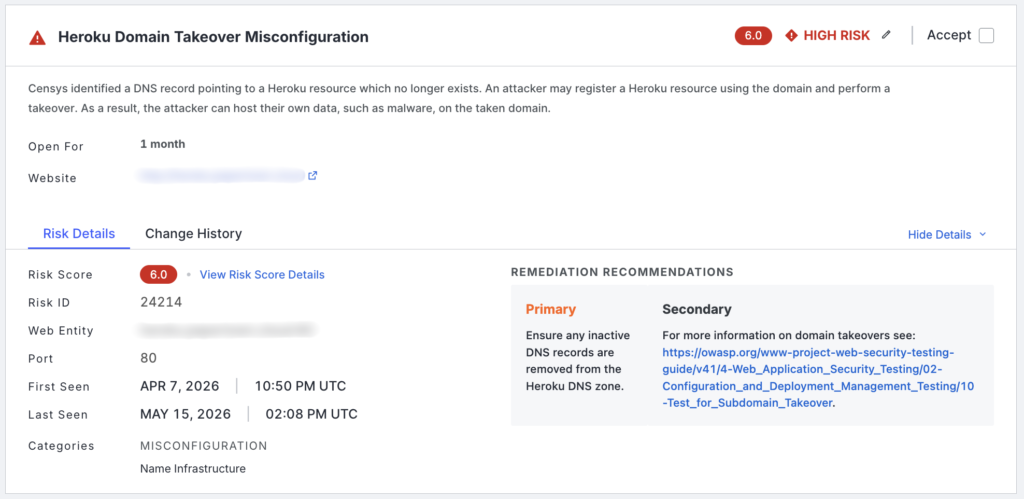
The root of this vulnerability lies in the decoupling of DNS zone management from cloud resource provisioning lifecycle strategies. Organizations frequently utilize Canonical Name (CNAME), Name Server (NS), or Pointer (PTR) records to route traffic to third-party providers such as Amazon Web Services (AWS) S3, GitHub Pages, Heroku, Azure App Services, or Fastly. When a development team dismantles an application or deletes a specific cloud bucket, the underlying provider releases that namespace (e.g., company-bucket.s3.amazonaws.com) back into the global pool of available names.
If the corresponding CNAME record within the enterprise authoritative DNS zone is not concurrently purged, it becomes “dangling.” The record remains globally resolvable. When a client queries the subdomain, the authoritative DNS server dutifully returns the CNAME target. An attacker needs only to register an account on that same third-party cloud platform and claim the exact namespace that the dangling CNAME points to. From that moment forward, all internet traffic destined for the enterprise’s trusted subdomain is seamlessly routed to infrastructure fully controlled by the threat actor, without requiring any unauthorized access to the enterprise’s primary DNS management console.
Automated Adversarial Reconnaissance and Exploitation Frameworks
From an offensive security perspective, locating dangling DNS infrastructure requires very little overhead and can be fully automated at scale. Threat actors leverage distributed computing arrays to continuously ingest Certificate Transparency (CT) logs, execute massive passive DNS (pDNS) queries, and run high-velocity dictionary-based subdomain brute-forcing tools. Once a list of valid subdomains is compiled, automated exploitation scripts programmatically evaluate the DNS resolution paths
If a subdomain maps via a CNAME to a cloud platform but yields a distinct error profile—such as an HTTP 404 Not Found containing signature platform headers (e.g., “NoSuchBucket” from AWS S3 or “There is no app here” from Heroku)—the automation flags the target as vulnerable. The threat actor then programmatically calls the platform’s API to claim the abandoned name. This exploit bypasses traditional signature-based network intrusion detection systems (IDS) because the DNS resolution itself is structurally legitimate and authorized by the victim organization’s own name servers.
Downstream Security Cascades and Blast Radius Assessment
The implications of a successful subdomain takeover are broad and severe, undermining fundamental web security assumptions and identity boundaries. Because the malicious infrastructure is hosted under a legitimate, high-reputation corporate domain, it inherits the explicit trust established with both users and security algorithms. This allows attackers to execute highly convincing spear-phishing campaigns, host active malware distribution nodes, and craft credential harvesting forms that easily evade basic URL reputation filters.
Furthermore, subdomain takeovers completely bypass the Same-Origin Policy (SOP) mechanisms built into modern browsers. An attacker operating a compromised subdomain can read and manipulate cookies scoped to the parent wildcard domain (*.example.com). This specific capability facilitates widespread session hijacking, OAuth token theft, and cross-site scripting (XSS) delivery. It can also disrupt protected API endpoints that rely on domain-level whitelisting for access control, turning a simple administrative oversight into a severe, multi-vector data breach.
Remediation Latency and the Failure of Manual Auditing
In large-scale enterprise environments, maintaining an accurate, manually verified ledger of DNS records is practically impossible. Enterprise networks frequently encompass tens of thousands of DNS records spread across legacy business units, multi-cloud deployments, and shadow IT projects. The primary operational failure occurs because infrastructure deletion checklists are rarely linked to DNS decommissioning workflows. If a DevOps engineer deletes a virtual machine or cloud instance but lacks administrative permissions to modify the corporate DNS zone, the record is simply left behind.
This creates a widening visibility gap. Traditional internal network vulnerability scanners focus heavily on active IP addresses and open ports, meaning they completely miss dangling CNAME records pointing to external, third-party infrastructure. Conversely, adversaries do not face these internal silos; they observe the network from an external perspective, validating the entire external attack surface continuously. This asymmetry leaves organizations exposed for months or even years unless they shift from periodic, manual point-in-time audits to continuous, automated external asset monitoring.
Continuous Attack Surface Monitoring via External Datasets
To effectively mitigate the risk of dangling DNS entries before exploitation occurs, security operations teams must adopt a continuous, data-driven approach to Attack Surface Management (ASM). This defensive model requires real-time integration with global Internet mapping engines, such as Censys ASM, which actively scan the entire IPv4 and IPv6 address space alongside authoritative DNS records. By maintaining an updated, comprehensive graph of the internet, these platforms continuously resolve an enterprise’s discovered domain assets, track every active CNAME and NS mapping, and parse the live responses returned by the target hosts.
When the monitoring system detects a CNAME pointing to a known third-party provider, it cross-references the destination’s active state against known signatures of abandoned infrastructure. If a target cloud endpoint returns an unallocated status, the platform triggers an automated, high-priority alert within the security team’s workflow (such as a SIEM or SOAR platform). This contextual alert provides security analysts with the exact domain name, the underlying stale record data, and the cryptographic or behavioral evidence required to rapidly verify the vulnerability. This enables teams to promptly purge the stale record from their zone file or re-provision the cloud asset before an attacker identifies the opening.
Our Opinion on the Dangling DNS Threat Landscape
The technical reality of dangling DNS entries highlights a fundamental flaw in modern enterprise security strategies: the systemic decoupling of cloud asset lifecycles from core network infrastructure management. In our view, organizations continue to treat DNS as a static, set-it-and-forget-it routing ledger rather than the highly dynamic, fluid boundary that it actually is in a cloud-native ecosystem. This perspective creates a significant strategic advantage for threat actors, who use automation to find vulnerabilities far faster than internal security teams can with manual audits.
We believe that treating subdomain takeovers as minor configuration errors severely understates their true danger. The ability of an attacker to bypass the Same-Origin Policy and compromise wildcard session cookies fundamentally breaks the security model of modern web applications. Organizations can no longer rely on perimeter firewalls or traditional endpoint protection to stop these attacks. To truly address this risk, security teams must automate their asset tracking to match the speed of their development teams. This requires deploying continuous external attack surface discovery tools and enforcing strict Infrastructure as Code (IaC) policies that mandate the synchronized destruction of DNS records alongside their corresponding cloud resources.
