

This article documents a critical security assessment conducted on a cloud-based document processing platform. What initially appeared to be a simple cross-site scripting (XSS) issue quickly evolved into a complete system compromise involving administrative account takeover and remote code execution (RCE) on the underlying server.
The attack did not rely on advanced exploits or unknown vulnerabilities. Instead, it leveraged common weaknesses, poor validation logic, and unsafe integrations between components. By chaining together multiple flaws, an attacker could move from unauthenticated access to full control over the system.
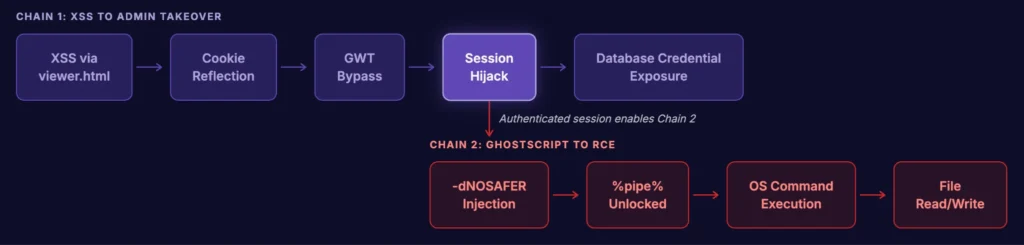
Two main attack paths were identified. The first allowed session hijacking despite HttpOnly protections, leading to administrative access. The second enabled command execution through unsafe use of GhostScript. When combined, these issues created a worst-case security scenario.
Application Overview
The target system was an enterprise-grade document processing solution designed to ingest, transform, and extract data from large volumes of files. It was built using a Java backend, a GWT-based frontend, and exposed functionality through REST APIs and Swagger.
The application architecture suggested that all operations required authentication. However, during testing, this assumption was challenged by systematically probing exposed endpoints.
Initial Entry Point: Unauthenticated XSS
One endpoint stood out immediately:/app/viewer.html
This endpoint accepted a URL parameter, fetched remote content, and directly injected it into the DOM using innerHTML without sanitization. This created a classic reflected XSS vulnerability.
An attacker could craft a malicious link pointing to attacker-controlled content. When a victim opened this link, arbitrary JavaScript would execute within the application’s trusted context.
Understanding the HttpOnly Limitation
The application used the HttpOnly flag on session cookies, which prevents JavaScript from directly reading them. At first glance, this appeared to mitigate session theft.
However, XSS does not require direct cookie access to be dangerous. Since the malicious script executes in the application’s origin, it can send authenticated requests. The browser automatically attaches cookies, including HttpOnly ones.
The real question became:
Is there any endpoint that exposes sensitive session data in its response?
Discovery of Cookie Reflection
Further testing revealed a GWT-RPC service endpoint that returned session-related data. When accessed with valid credentials, it responded with all cookies, including the protected session identifier.
This meant the server itself exposed what the browser tried to protect.
Even more concerning, this endpoint relied on security tokens meant to prevent misuse. These included a header and a request hash. However, validation was weak. The system only checked whether these values existed, not whether they were correct.
By sending arbitrary values, the endpoint still returned sensitive information.
Building the Exploit Chain
At this stage, two key weaknesses were identified:
- XSS allowing JavaScript execution in a trusted context
- A backend endpoint exposing session cookies
These were combined into a single attack:
- The victim opens a malicious link
- The injected script sends a request to the vulnerable endpoint
- The server responds with session data
- The attacker exfiltrates the response to an external server
- The stolen session is reused to impersonate the victim
This bypassed HttpOnly completely, not by breaking it, but by exploiting server-side behavior.
Privilege Escalation: Administrative Control
Once an administrator’s session was obtained, the attacker gained unrestricted access to:
- Application configurations
- User data and accounts
- Uploaded documents
- System-wide settings
Additionally, another serious issue surfaced. A database connection testing feature exposed credentials in plaintext within network requests. While the UI masked passwords, the backend transmitted them openly.
This allowed attackers to extract database credentials and potentially access the database directly.
Second Attack Chain: GhostScript Exploitation
While exploring further, attention shifted to document processing functionality. A REST endpoint handled file processing using GhostScript:
POST /app/rest/processDocument
This endpoint was accessible to any authenticated user. It accepted parameters that were passed directly to the GhostScript engine, including a field named renderOptions.
No validation was applied to this input.
Parameter Injection
GhostScript includes a security feature called -dSAFER, which restricts dangerous operations. However, by injecting -dNOSAFER, an attacker could disable these protections.
Since the application passed user input directly to the command line, it allowed full control over GhostScript execution behavior.
Achieving Remote Code Execution
A specially crafted PostScript file was uploaded. Inside it, a hidden command used GhostScript’s %pipe% functionality to execute system commands.
The payload triggered a DNS request to an attacker-controlled server, confirming command execution.
This proved that arbitrary commands could run on the host system.
Impact Demonstration
To validate the severity, controlled tests were performed:
System Enumeration
Commands were executed to retrieve system information such as hostname.
File Read Capability
Sensitive files (e.g., system configuration files) were accessed and exfiltrated.
File Write Capability
Files were written to the web-accessible directory, proving persistence was possible.
This meant an attacker could deploy web shells or modify application behavior permanently.
Complete Attack Scenario
Two separate vulnerability chains were identified:
Chain 1: XSS to Admin Takeover
- Unauthenticated XSS via viewer endpoint
- Cookie exposure through backend service
- Weak validation of security tokens
- Session hijacking
- Access to admin features and database credentials
Chain 2: GhostScript to RCE
- Unsafe parameter handling
- Disabling security features
- Command execution via PostScript
- File system access (read/write)
Together, these allowed an attacker to move from no access to full server compromise.
Broader Security Observations
Several key lessons emerged from this case:
- HttpOnly cookies are not enough if the backend leaks them
- Security controls must validate data, not just check for presence
- Document processing tools introduce high-risk attack surfaces
- Passing user input into system-level tools without filtering is extremely dangerous
This case highlights how small issues can escalate when combined.
CyberP1 Analysis and Opinion
From a professional security standpoint, this case is a strong example of how modern applications fail not because of a single critical bug, but because of multiple small oversights that interact in unexpected ways.
What stands out most is not the presence of vulnerabilities themselves, but how predictable they were. None of the issues involved advanced exploitation techniques. Cross-site scripting, weak validation, and unsafe command execution are all well-known risks. Yet, their coexistence in the same system reflects gaps in secure development practices and threat modeling.
The misuse of HttpOnly cookies is particularly notable. Many teams assume that enabling HttpOnly is sufficient protection against session theft. This case clearly demonstrates that backend behavior matters just as much as frontend controls. If the server exposes session data anywhere, the protection becomes meaningless.
Another critical concern is the flawed implementation of security mechanisms. The GWT protection tokens were present, but ineffective. This creates a false sense of security, which is often more dangerous than having no control at all. Developers may believe the system is protected when, in reality, it is easily bypassed.
The GhostScript issue further reinforces the importance of treating third-party tools as part of the attack surface. Integrating powerful processing engines without strict input validation essentially hands attackers a toolset for exploitation.
From an operational perspective, the exposure of database credentials in plaintext suggests a lack of secure coding standards and insufficient review processes. Sensitive data handling should never rely on frontend masking alone.
Overall, this incident reflects a systemic issue rather than isolated mistakes. Secure development requires a holistic approach, where each component is evaluated not just individually, but also in how it interacts with others.
In our view, the most important takeaway is the need for layered defense. No single control should be trusted entirely. Proper input validation, secure configuration, and continuous testing must work together.
This case serves as a reminder that attackers do not think in terms of individual vulnerabilities. They think in chains. Defenders must do the same.
